



Starting a new job can be exciting, but the first few days can also feel unfamiliar. New employees need to understand their responsibilities, meet their colleagues, learn workplace systems, and become comfortable with the company culture.
A thoughtful employee welcome kit can make this transition easier.
A custom welcome kit is more than a box filled with company merchandise. When planned properly, it can introduce a new employee to the organization, provide useful workplace essentials, communicate company values, and create a positive first impression.
For businesses in Dubai, welcome kits can be especially valuable because workplaces often bring together employees from different countries, cultures, and professional backgrounds. A carefully designed custom employee onboarding kit can help create a shared sense of identity while still respecting individual preferences.
This guide explains what to include, how to design the kit, what mistakes to avoid, and how businesses can make their onboarding gifts more useful and memorable.
Why Custom Welcome Kits Matter for New Employees
The first impression an employee receives from a company can influence how they view the organization.
A disorganized first day may make a new employee feel uncertain. A prepared and thoughtful welcome can communicate that the company values its people.
A new hire welcome kit can support this experience by giving employees practical items while introducing them to the company’s identity.
More Than Just Corporate Merchandise
A welcome kit should have a purpose.
It can help employees:
- Feel welcomed from their first day
- Understand company culture
- Organize their work
- Identify themselves as part of the team
- Learn important workplace information
- Start using company resources
- Feel recognized as individuals
The best kits combine useful products with information and personal touches.
Why Customization Makes a Difference
Customization allows a business to create a kit that feels designed specifically for its employees.
This could involve:
- Company branding
- Employee names
- Department-specific items
- Customized packaging
- Company values
- Personalized welcome notes
- Products selected for the employee’s role
The objective is not to add a logo to every object. The objective is to create a consistent and useful onboarding experience.
What Should a New Employee Welcome Kit Include?
There is no single formula that works for every company. The contents should depend on the industry, employee role, office environment, and company culture.
A practical corporate welcome kit can contain a combination of these categories:
| Category | Possible Items | Main Purpose |
|---|---|---|
| Work essentials | Notebook, planner, pen | Daily productivity |
| Technology accessories | Phone stand, cable organizer, laptop sleeve | Easier device use |
| Personal items | Bottle, mug, tote bag | Everyday convenience |
| Company information | Welcome guide, team directory | Faster orientation |
| Personalized items | Name card, customized notebook | Recognition |
| Culture materials | Values card, employee handbook | Cultural introduction |
| Comfort items | Desk accessories | Better workspace experience |
The company does not need to include everything.
It is better to select a smaller group of relevant items than to fill a box with products employees may never use.
Essential Work Items for a Useful Welcome Kit
The practical section of the kit should help the employee settle into their daily routine.
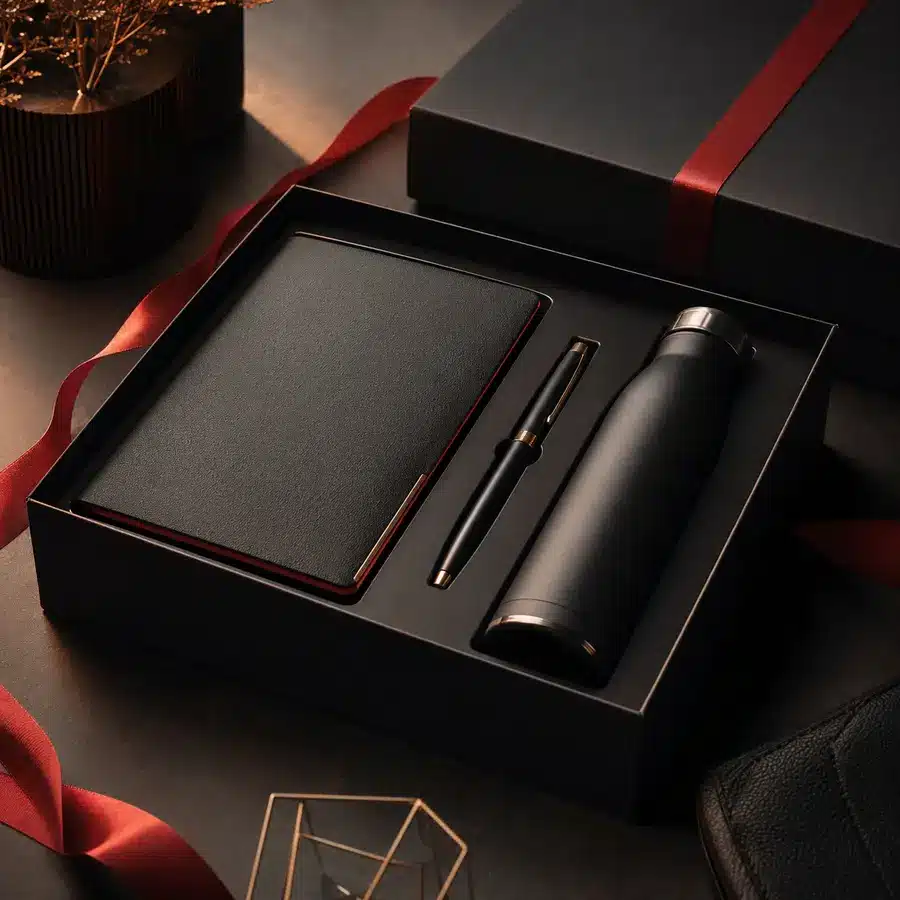
Notebook and Pen
A quality notebook can be useful during meetings, training sessions, brainstorming, and personal planning.
Adding the employee’s name can give a simple stationery item a more personal feel.
A pen should also be comfortable and reliable. If the company chooses branded stationery, the branding should remain clean and professional.
Planner or Productivity Tool
A planner can help employees organize meetings, tasks, and priorities during their first few weeks.
Companies with highly structured workflows may also create a simple branded productivity guide explaining how teams manage tasks and deadlines.
Desk Organizer
A compact organizer can help employees keep frequently used items in one place.
It can be particularly useful for office-based employees who have assigned desks.
Employee Identification Items
Depending on workplace requirements, the kit may include:
- Employee ID holder
- Name card
- Lanyard
- Access-card holder
- Department identifier
These items can make the employee feel integrated into the workplace from day one.
Technology Accessories for Modern Employees
Many employees depend on laptops, smartphones, tablets, and other devices throughout the working day.
Technology accessories can therefore be valuable additions to a personalized employee welcome kit.
Useful Technology Products
Consider items such as:
- Laptop sleeve
- Phone stand
- Cable organizer
- Screen-cleaning cloth
- USB hub
- Charging accessory
- Wireless mouse
- Keyboard accessories
The exact selection should depend on the company’s equipment policy.
Avoid Unnecessary Technology
Not every electronic accessory belongs in a welcome package.
Before including a technology product, check:
- Is it compatible with company devices?
- Will most employees use it?
- Does it meet workplace security requirements?
- Is it durable?
- Does the employee already receive an equivalent item from IT?
Coordination between HR and IT can prevent unnecessary duplication.
Personalized Items That Make Employees Feel Valued
Personalization can turn a standard onboarding package into a more memorable experience.
Add the Employee’s Name
Simple personalization can include:
- Name on a notebook
- Personalized name card
- Customized desk plate
- Initials on a work accessory
The personalization should feel intentional rather than excessive.
Include a Personal Welcome Message
A short message from a manager or team can have more emotional value than another promotional product.
The message could mention:
- The employee’s role
- Their joining date
- Their team
- What the company is excited about
- Where they can find support
This helps connect the physical kit with the human side of onboarding.
Celebrate the Employee, Not Only the Brand
A common mistake is designing the entire package around the company logo.
A better approach gives the employee equal importance.
For example:
Company-focused approach:
Large logo + multiple promotional products.
Employee-focused approach:
Personalized essentials + useful information + subtle branding + welcome message.
The second approach usually creates a more thoughtful experience.
Dubai-Specific Considerations for Employee Welcome Kits
Businesses operating in Dubai should consider their workforce, office environment, and local working culture when creating onboarding packages.
Think About a Multicultural Workforce
Many Dubai organizations employ people from different countries and cultural backgrounds.
Choose products that are practical and broadly suitable.
Useful everyday accessories generally work better than highly specific items that may not appeal to everyone.
Consider Office and Remote Employees
Not every employee works from a traditional office.
A Dubai company may have:
- Office-based employees
- Hybrid workers
- Remote employees
- Field teams
- Sales representatives
- Employees who travel frequently
Their kits can be adjusted accordingly.
| Employee Type | Useful Welcome Kit Focus |
|---|---|
| Office employee | Desk essentials and stationery |
| Remote employee | Home-office accessories |
| Sales employee | Portable work accessories |
| Manager | Professional planning tools |
| Field employee | Durable portable essentials |
| Hybrid employee | Travel-friendly technology accessories |
Keep the Design Professional
Dubai’s corporate environment includes everything from startups to multinational companies.
The kit should match the company’s professional image.
A financial firm may prefer a minimalist presentation, while a creative company may use a more expressive design.
How to Design the Perfect Custom Welcome Kit
Creating a good kit requires more than choosing products.
The entire experience should feel connected.
Start With the Employee Journey
Think about what happens from the moment the employee receives the package.
Ask:
- What do they see first?
- What information do they need?
- Which items will they use immediately?
- What can help them understand the company?
- What will they still use after several months?
This approach helps companies avoid unnecessary merchandise.
Build the Kit Around Three Layers
A useful framework is:
Layer 1: Practical
Products that support everyday work.
Layer 2: Informational
Materials that explain the organization and onboarding process.
Layer 3: Emotional
Personal touches that make the employee feel genuinely welcomed.
When all three layers work together, the kit becomes more than a collection of branded items.
Welcome Kit Ideas by Company Type
Different businesses can take different approaches to employee onboarding gifts.
Technology Companies
A technology business might include:
- Laptop sleeve
- Cable organizer
- Phone stand
- Notebook
- Wireless accessory
- Company culture card
The focus can be on productivity and modern work.
Creative Agencies
A creative agency could emphasize:
- Premium notebook
- Sketchbook
- Custom stationery
- Desk accessory
- Creative welcome card
- Branded tote
The design can reflect the company’s visual personality.
Professional Services Firms
Consulting, finance, legal, and business service organizations may prefer:
- Professional notebook
- Quality pen
- Planner
- Document folder
- ID holder
- Employee handbook
The presentation should remain clean and professional.
Hospitality Businesses
Hospitality companies can create kits around their service culture.
Potential additions include:
- Personalized name badge
- Notebook
- Bottle
- Employee guide
- Department information
- Branded personal accessory
The kit can introduce employees to both the organization and its service standards.
Common Mistakes to Avoid When Creating Welcome Kits
A welcome kit can lose its value when companies focus on quantity rather than relevance.
Mistake 1: Filling the Box With Promotional Products
Employees do not necessarily want a collection of items covered in logos.
Choose products based on usefulness.
Mistake 2: Ignoring Employee Roles
A designer, accountant, salesperson, and warehouse employee may have very different needs.
Where practical, customize the contents according to the job.
Mistake 3: Providing Poor-Quality Products
Low-quality accessories can create an unintended impression about the employer.
Check the durability and usability of products before distributing them.
Mistake 4: Forgetting Important Information
A welcome kit should not be only physical merchandise.
Consider including information about:
- Company values
- First-week schedule
- Key contacts
- Workplace policies
- Communication channels
- Office facilities
- Team structure
Mistake 5: Making the Kit Too Complicated
Employees should understand what each item is for.
Simple organization usually creates a better experience than an overloaded package.
Expert Tips and Best Practices for Better Welcome Kits
A few improvements can make an employee onboarding gift much more effective.
Give the Kit at the Right Time
Ideally, the employee should receive the kit early enough to make the first day feel organized.
For remote employees, companies can arrange delivery before onboarding where practical.
Coordinate HR, IT, and Management
HR may handle onboarding.
IT may provide equipment.
Managers may introduce the employee to the team.
These groups should coordinate so the welcome kit complements the wider onboarding process.
Add a Digital Welcome Experience
A physical kit can be supported by digital resources.
For example, a printed card can point employees toward internal systems or onboarding resources without making the physical package unnecessarily large.
Refresh the Kit Regularly
Employee expectations change.
Review the kit periodically and ask:
- Which products are actually used?
- Which items receive positive feedback?
- Which products remain unused?
- What do new employees wish they had received?
- Are the materials still accurate?
Use the answers to improve future kits.
How to Measure Whether Your Welcome Kit Works
A welcome kit is not successful simply because employees receive it.
Companies should look at employee feedback and onboarding outcomes.
Useful Feedback Questions
HR can ask:
- Which item did you use most?
- Which item was least useful?
- Did the kit make you feel welcomed?
- Was the information easy to understand?
- What would you add?
- What would you remove?
A short survey can provide valuable insights.
Simple Evaluation Framework
| Area | Question |
|---|---|
| Usefulness | Did employees use the products? |
| Personalization | Did employees feel the kit was made for them? |
| Information | Did it help with onboarding? |
| Brand connection | Did it communicate company identity? |
| Quality | Were the products durable? |
| Feedback | Would employees recommend keeping the kit? |
The results can guide future improvements.
Example of a Thoughtful Dubai Employee Welcome Kit
Imagine a Dubai-based marketing company hiring a new SEO executive.
Instead of giving the employee a generic promotional box, the company creates a role-friendly onboarding package.
It contains:
- Personalized notebook
- Comfortable writing pen
- Laptop sleeve
- Cable organizer
- Reusable bottle
- Employee ID holder
- Company culture guide
- First-week checklist
- Personalized welcome note from the manager
On the first day, the manager explains the purpose of the items and introduces the employee to the team.
The company then asks for feedback after the employee has completed the first month.
This approach connects the custom corporate gifts with onboarding rather than treating them as isolated merchandise.
Conclusion
A custom welcome kit can make a new employee’s first days more organized, comfortable, and memorable. The strongest kits do not focus on the number of branded products inside the box. They focus on relevance, usefulness, personalization, and a genuine welcome.
For Dubai businesses, it is important to consider multicultural teams, different working arrangements, professional expectations, and individual job requirements.
A good new employee welcome package should answer three simple questions:
- Does it help the employee?
- Does it introduce them to the company?
- Does it make them feel welcomed?
If the answer is yes, the kit is doing more than displaying a logo. It is becoming a practical part of the employee experience.
FAQs
What should be included in a custom employee welcome kit?
A useful kit can include a notebook, pen, laptop accessory, bottle, ID holder, company information, welcome message, and other products that match the employee’s role and workplace needs.
Should employee welcome kits be personalized?
Yes. Personalization such as an employee’s name, initials, department, or a message from their manager can make the onboarding experience feel more thoughtful.
What makes a good welcome kit for employees in Dubai?
A good Dubai welcome kit should be practical, professional, culturally appropriate, and suitable for the company’s working environment. It should also work well for different employee roles and work arrangements.
Should every employee receive the same welcome kit?
Not necessarily. A core kit can remain consistent while selected items are adapted for different departments, job roles, or working arrangements.
When should a new employee receive their welcome kit?
The kit should ideally be available at the beginning of the onboarding experience. For remote employees, sending it before their first working day can help create a more organized introduction to the company.

Rosalina D. Willaim
Blogger/Photographerhe whimsically named Egg Canvas is the design director and photographer in New York. Why the nam

September 19, 2026

September 19, 2026
Choosing the Right Corporate Gift for Different Business Relationships

September 19, 2026